Dead Car, Live Expenses: The Real Cost of Keeping a Non-Runner in Your Driveway

Let's be real for a second. That dead Chevy Silverado hasn't moved since last Thanksgiving. You keep telling yourself you'll fix it "when things settle down," but meanwhile it's just sitting there, soaking up money you probably don't even realize you're spending.
Here's the thing — a non-running car isn't a neutral object parked in your life. It's an active financial drain. And when you lay out the actual numbers, the case for junking it becomes pretty hard to argue with.
The Insurance Trap Most People Fall Into
Let's start with the one that surprises people the most: insurance.
A lot of car owners assume they can just "pause" their coverage on a vehicle that doesn't run. And technically, you can drop your car down to comprehensive-only (which covers theft and weather damage but not liability), but many people just... don't bother. They keep paying full coverage on a car that goes nowhere.
Full coverage on a vehicle worth less than $2,000 — which is the ballpark for many non-runners — can run anywhere from $600 to $1,200 per year depending on your state, your driving history, and your insurer. Even if you've dropped it to comprehensive-only, you're still likely paying $150 to $400 annually for coverage on a car that can't move under its own power.
That's money leaving your wallet every month for a vehicle that gives you absolutely nothing in return.
Registration Fees Don't Care If the Car Runs
Depending on which state you're in, annual vehicle registration can range from a modest $20 in some rural states to well over $200 in places like California or New York. The average across the US hovers somewhere around $80 to $150 per year.
Here's the kicker: most states still require you to keep a non-running vehicle registered if it's parked on public property — or even on private property in some jurisdictions. Miss the renewal and you can face fines, liens, or complications when you eventually try to sell or transfer the title.
So you're either paying the registration fee every year, or you're risking penalties. Neither option is free.
Storage: The Cost You're Paying Without Realizing It
If the car is in your garage, it's probably pushing out something that actually has value — your daily driver, tools, a workspace, or just usable square footage. If you're in an area where garage space is at a premium, you could be losing the equivalent of $100 to $300 per month in usable real estate.
Renting a garage space or storage unit to house a non-runner? That's an even more obvious money pit, often running $75 to $200 per month depending on your city.
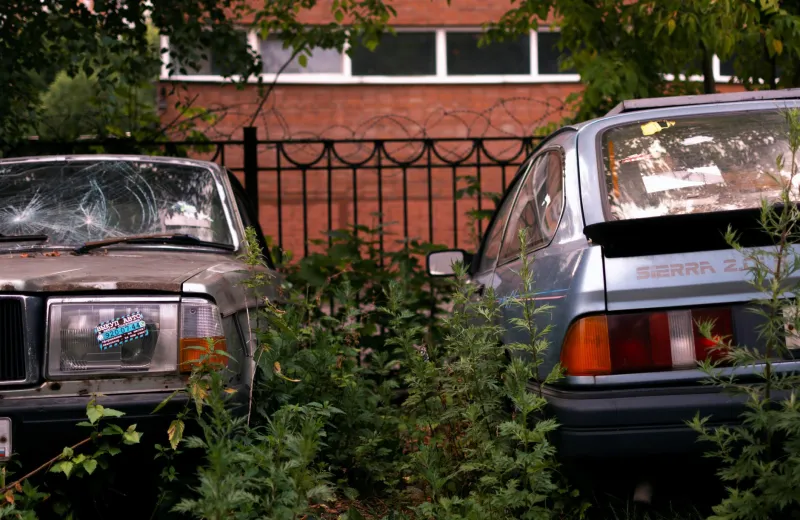
And if it's in the driveway? In some municipalities, a visibly deteriorating or inoperable vehicle can get you cited. Code enforcement violations can carry fines starting at $50 and climbing into the hundreds if left unresolved.
The Opportunity Cost Nobody Talks About
Here's where the math gets a little more abstract but no less real. Every month that car sits there is a month you're not putting that cash toward something that works in your favor.
Let's say a junk car buyer would give you $500 for your non-runner today. That's $500 you could put toward:
- A down payment on a reliable used vehicle
- Paying down a high-interest credit card
- Building up an emergency fund
- Literally anything else
Instead, that potential $500 is locked up in a depreciating hunk of metal that's also costing you money on top of it. Junk car values are not static — they generally trend downward as the vehicle deteriorates further, parts become harder to sell, and scrap metal prices fluctuate. The $500 offer you'd get today might be $350 six months from now.
A Real-World Scenario: Running the Numbers
Let's put this all together with a realistic example.
Say you've got a 2009 Honda Accord that threw a rod and hasn't started in eight months. Here's what holding onto it for one full year might actually cost you:
| Expense | Annual Cost |
|---|---|
| Reduced insurance (comprehensive-only) | $250 |
| State registration renewal | $120 |
| Lost garage/driveway value (conservative) | $600 |
| One code enforcement warning/fine | $75 |
| Total annual cost of doing nothing | $1,045 |
Now compare that to what you'd walk away with if you junked it: somewhere between $300 and $800 depending on the vehicle's weight, condition, and your local market — with free towing included, so that cost is zero on your end.
The swing between "keep it" and "junk it" over 12 months? Potentially $1,300 to $1,800 in your favor if you act now rather than wait.
"But I Might Fix It Someday"
This is the most common reason people hold onto non-runners, and it deserves an honest look.
If you've had the car sitting for more than six months and haven't started the repair process, statistically speaking, you probably won't. Life gets busy. Repair estimates come back higher than expected. A newer, more reliable vehicle enters the picture.
And if the repair cost exceeds the vehicle's actual market value — which is extremely common for older cars with major mechanical failures — fixing it isn't really a financial win anyway. You'd be spending $2,500 to restore a car worth $1,800 on a good day.
The emotionally hard truth: "someday" is costing you real money right now.
What Junking Actually Looks Like
A lot of people picture junking a car as a complicated, messy process. It's really not. Services like WM Junk Cars handle the entire thing — they come to you, handle the towing at no charge, give you cash on the spot, and take care of the title transfer paperwork. The whole thing can be done in a matter of hours from the time you call.
No hauling the car anywhere. No negotiating with a mechanic. No more registration renewals for a car that doesn't move.
The Bottom Line
Keeping a non-running car isn't free — not even close. Between insurance, registration, storage costs, potential fines, and the slow erosion of the car's junk value, holding on to that dead vehicle can easily cost you $1,000 or more per year while simultaneously shrinking the payout you'd get if you sold it.
Junking your car isn't giving up. It's running the numbers and making the smart call. And right now, that call is probably worth a few hundred dollars in your pocket and a lot of freed-up space in your driveway.